

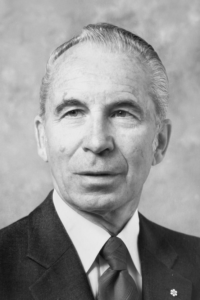
Len Shebeski was born in Aubigny, Manitoba on August 5, 1914, moving to Arborg, Manitoba in 1917. He was educated in Arborg and at the University of Manitoba where he received an undergraduate degree in agriculture. Following graduation, Len served in the Royal Canadian Air Force as Observer and Pilot. After the war, he completed a Master’s Degree in Plant Science at the University of Manitoba. Following further graduate training at the University of Minnesota, he taught at the University of Saskatchewan. In 1953, he returned to the University of Manitoba as a professor and head of the Department of Plant Science, a position he held until 1965 when he was appointed Dean of the Faculty of Agriculture and Home Economics. When Home Economics became a separate faculty in 1970, he continued as Dean of Agriculture until his retirement in 1979.
Len was a strong believer in interdisciplinary co-operation in research. He earned national and international acclaim for spearheading the development of the new cereal crop with wheat and rye parentage that he called triticale. Triticale is still produced for its high protein content and is used by plant breeders to produce desirable traits in other cereals. He was also a key player in the development of Canada’s first utility wheat variety, Glenlea.
Len had a strong sense of the important international role Canadians could play in improving food production. He was associated with Canadian International Development projects in Thailand, Kenya and Zambia.
His professional activities in Canada included positions with the National Research Council, Science Council of Canada, the Agricultural Institute of Canada and the Canadian Agricultural Research Council. He also served the Canadian Seed Growers Association, the Manitoba Weeds Commission and the National Advisory Committee on Agriculture for Expo ’67. He was a Honourary Director of the Royal Manitoba Winter Fair in Brandon.
Dr. Shebeski holds honourary degrees from the University of Saskatchewan, Queen’s University, the University of Manitoba and the Warsaw Agricultural University of Poland. He is a fellow of the Agricultural Institute of Canada and of the Royal Society of Canada, and a foreign member of the Lenin All-Union Academy of Agricultural Sciences in Moscow. In 1977, he became an Officer of the Order of Canada.
Len also served in leadership positions with Home and School, Manitoba Track and Field and the Manitoba Division of the Canadian Red Cross Society.
In 1945, Len married Laura Stewart. They had four daughters: Janice (Harper), Kathryn (Hatcher), Peggy (King) and Elain.
Len’s entire working life was spent striving to improve conditions for producers in Manitoba, Canada and worldwide.